Showing posts with label Design. Show all posts

Friday, December 16, 2011

Beauty In The Desert - A Note to My Design Community


After reading this tweet from the design community's very own @JamesSwan this week, I decided to tell you about a project that is close to my heart.

At the end of February, this coming year, I will be heading up a monumental task: to build a house in a week … in Mexico. I had the opportunity to help with an Extreme Home Makeover here in Nashville a year or so back and I know pulling that off in a week in America, with corporate sponsors and large contractors, was crazy; to try doing it in Mexico with donated materials and all-volunteer labor is quite, well, mad. Why am I involved, you ask? For many reasons, but I will only give you a couple.

For the past three years I have spent my time volunteering at Rancho De Sus NiƱos, an orphanage just outside of Tecate, Mexico. I say orphanage because that is how it began 20-plus years ago; these days it is actually an orphanage, a daycare, a K-through-college school system, a hospice, and a ministry providing free, clean drinking water to area families and garbage service so their community doesn't have to live in filth. It has grown because Rancho people see a need, fill it, and worry about the funding later. It is a faith-based organization and they are being the hands and feet of God. You don't even have to be religious to see the good they do and the financial and social change they bring to a very impoverished area. The couple that runs Rancho, Jimmy and Genea Horner, left a very successful land development and homebuilding business in Southern California to bring their time, talent and treasure to those in need.

So, February 29th through March 7th we will build a house -- a 2,272-square foot, seven-bedroom, three-bath house, completely furnished, at a cost of $70,000. That is only about $31 per square foot; for reference, the average cost per square foot to build in Nashville is around $110 per square foot, unfurnished. I have included a snapshot of the floor plan so you can see the layout. 

Plan View
Now that we have all the particulars out of the way, this is what I am asking my fellow designers, architects, decorators, craftsmen, anyone in the design community: help me with this project. You can donate funds via Hopepark Church (select "Other" and please mark your contribution “Rancho House in a Week.”) All donations are tax deductible. You can talk to your vendors about donating goods and services -- we need everything from concrete to pillowcases. Or you can lend us a hand, literally -- I would love to see some of you actually come to Mexico with me. Post a comment below, follow the links provided, or message me on Twitter (@Billy_Williams) to let me know how you would like to contribute ... you might even have a way that I’ve not thought of. Even if you are unable to help right now, there may be someone in your world who can. So re-post, tweet, facebook, spread the word by carrier pigeon if you have to … just spread the word.

As a design community we have the daily privilege of bringing beauty, form and function to our clients’ lives. Join me in bringing beauty to the desert ... to people who would never be able to afford our services or benefit from our talents.

Thank you,
b.

Saturday, November 12, 2011

Why Are We Afraid to Innovate?

Innovation...inspiration...imitation...limitation...exasperation...

These seem to be the five phases of design. We start out to innovate, look for inspiration, which usually leads to imitation, where we see our (perceived) creative limitations, which eventually leads to total exasperation. Do we follow this chain of events because we doubt our own eyes or brains ... maybe because we are afraid to put forward what we think is innovative because someone will shoot it down? Creativity leaves us very vulnerable.

One of my favorite quotes comes from Henry Miller: "Every day we slaughter our finest impulses. That is why we get a heartache when we read those lines written by the hand of a master and recognize them as our own, as the tender shoots which we stifle because we lack the faith to believe in our own powers, our own criterion of truth and beauty." The line that strikes me the most is "...we lack the faith to believe in our own powers, our own criterion of truth" -- that is it in a nutshell. We don't believe what we imagine as innovation is true -- only those like the late Steve Jobs innovate, right? 

Apex Design ©2011 b. williams design
Earlier this year I was granted a great opportunity to design some concept kitchens with the idea that there was "no box." However, without the client's knowledge, their well-meaning ad agency began to send me image after image of what was "cutting edge," "innovative" -- before they had even seen what I could do. I actually never looked at the images they sent, as I felt it would taint my creativity and not allow me to do what I had been asked. I know that sounds egotistical but hear me out. They were sending images from magazines. Now consider the timeline associated with those images. The magazine article was four months old which means the story was most likely written five months ago, which means the project was at least eight to nine months in the build phase; add another six to 12 months from conception to actual building date. This means by the time I see this innovative design it is already two years old or older. To have designed from those images would have been imitated innovation at best. 

I have an Android phone; it seems innovative in a "How can we compete with iPhone" kind of way. Apple did (does) a great job innovating so by the time HTC imitates Apple's newest device, that device is old news and Apple is on to the next innovation. Sometimes we don't innovate because we fear those around us just "won't get it" My designs were published in an article in an industry magazine. A few weeks later a highly successful architect friend of mine, whose views I greatly respect, spent a good amount of time telling why my designs were not right because they did not fit within the confines of historical architectural thinking. He said they were outside the "rules of design." My response would be, "Whose rules?" I didn't sign up to design so I could simply follow a rigid set of rules -- maybe I want to break the rule so it can be re-written. In my mind my designs worked, if for no other reason than they made him think. 

So here is my advice: innovate. Sit and design something out of your own mind, no matter how weird or unconventional it seems. (You might not want to do this on a work-for-hire -- or maybe you do.) Believe that YOU might know what the next innovation is, that YOU know what beauty is, that the crowd should follow YOU, not the other way around. Recently, I sent a kitchen design to a client where I took a chance and put a small door at the bottom of the upper cabinets and the larger door above. His comment  was, "Are you suggesting we put a drawer in the upper cabinet?!" I explained it was a door and that my concept was to set the look of his kitchen apart. I took a chance; it cost me nothing. He chose to go the traditional route but I like the idea and someday a client will like it, too.  

Saturday, June 18, 2011

Death By Committee

What's the quickest way to kill a good idea? Appoint a committee to discuss it.

This post will concentrate on working with your designer or architect or decorator to achieve the very best outcome. And my basic point here is, design-by-committee does not work.

Actually I consider design-by-committee the equivalent of painting by numbers. Does it look like a horse? Of course. Would you hang it in a museum? I hope not.

To execute any vision for a space, and my specialty is kitchens and baths, the reason you hire a professional is you need someone who is the visionary and has the expertise to know what will and won't work. Imagine having your dental work done by committee; the orthodontist has the vision and expertise, yet you check with everyone from the hygienist to the maintenance staff and come back to the doctor with their plan. It's safe to say you would have an interesting-looking grill.

So the first thing you should do is work with the designer, architect or decorator that you trust, and that doesn't necessarily mean their taste has to be your taste. It means they work in a professional realm and they can bring to fruition your design by interpreting your aesthetic. Where the trouble begins is where you don't believe your own criterion of truth and that fear causes you to second-guess the design choices. Most of the time when I encounter a client who wants to design by committee, it has more to do with their fear of making a decision and having to defend it later. Thus begins the journey into Committee Land, where every design aspect is run past a neighbor, a daughter-in-law, a daughter, a great Aunt, a cousin twice removed, someone you met in the grocery store and the yard guy, all who once watched an episode of something on HGTV and therefore, somehow, have more credibility with you than your own design team.

I'm not saying you shouldn't seek counsel, but when seeking that counsel begins to fragment the original design, look and feel, the trust begins to unravel between you and your design professionals. The design becomes convoluted. And 90-percent of the time, people end up with a final product that is very, very similar to what they began with.

So here are my five tips to save yourself from design death-by-committee:

1. Trust the professional. Not only will they help you create something much greater but in most cases will save you money by not allowing you to make mistakes.
2. Don't be swayed by well-meaning people's advice or criticism. Should you seek wise counsel? Yes. Do you always have to follow it? No.
3. Don't be afraid of change. Some people avoid design changes and blame it on not wanting to be "trendy" when, in actuality, anything on the market right now is the trend.
4. Relax and trust yourself. Your kitchen wall color is not a life game-changer; it's a kitchen wall color.
5. Have fun sharing your new designs with the aforementioned people confidently. If they don't like it, it's okay.
BONUS LIFE LESSON:
6. Never trust a man who wears suspenders and a belt; don't trust a man who doesn't trust his pants.

Friday, February 25, 2011

What's The Difference?


One of my Facebook friends had an interesting status the other day. It read, "What is the difference between art and decoration?" At first I just hit the "Like" button, considering it a nice ponder, but the question has been with me all week. What makes art "Art" and what makes other art simply "decoration"? It's the same question I ask myself about my favorite TV shows, "American Pickers" and "Hoarders" -- one man's trash is another man's treasure.


(Photo: Case Study #22 by Julius Shulman, Circa 1960 - Art in three styles: Architecture, Image, Photography Style. This image moves me.)

I think for me to answer the question honestly, I have to look at the effect each has on my heart and mind. I consider true art to be a very high calling. I don't necessarily have to like something to consider it art; actually the fact I don't like it may be the very thing that places it in the art category. Art always stirs emotion. There should be a visceral reaction to its form or color or subject -- or the lack thereof. Art has a tension to it. Consider Monet and Picasso, who painted things as they saw them, not as they actually were; there is the tension. Even masters of realism like Michelangelo and Titian created great tension in their work, drawing the viewer in, making us question why or how. Decoration, on the other hand, is neutral. It fills space and may be pleasant to the eye but it doesn't affect the heart.

Like most of you, I have many things in my home. Some items are there simply to keep the space from feeling empty and to add form and balance to a room: decorations. Then there are those pieces that capture my attention: art. These are the things I look at and ponder, their significance, my significance. They turn on that seldom-used part of my brain that searches for answers and craves beauty over clutter. I can look at them a million different times and feel a million different things. They are timeless and will not end up as garage sale fodder in the next few years as trends and tastes change.

How would you answer the question, "What is the difference between art and decoration?"

Monday, August 30, 2010

A Little Nip & Tuck (Working Within a Budget)

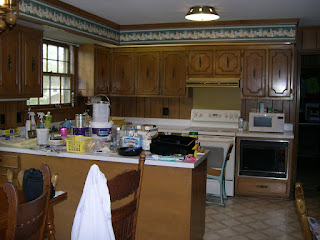
Not all kitchen makeovers have to be total remodels. Quite often a few well-thought upgrades here and there are all you really need to get your kitchen cooking again. I see a lot of '70s, '80s and even '90s kitchens that could be pulled from the world of drab into the world of fantastic with a simple face-lift.

This lovely 1970s kitchen actually had a lot going for it. The layout functioned just fine for the owners, a small but growing family. The cabinets themselves were dated by the door style, color and countertop materials but were well-built, giving us a good place to start. What the homeowner wanted was better lighting, a more modern look, and a more functional cabinet to replace a catch-all desk in the corner next to the refrigerator. And they wanted to be able to do it on a pretty modest budget.


Here were the solutions:
  • We had a local cabinet shop build new cabinet doors, and we painted and glazed the cabinets.
  • Horrible fluorescent soffit lighting and a single ceiling "salad bowl" fixture were replaced with ample recessed lighting -- remember it's always better to over-light and use dimmers rather than under-light a room and have to use a mining helmet to find your crock pot.
  • The old laminate countertops were replaced with a new textured stone-looking laminate, very attractive and, I might say, at a great price point.
  • Walls and trim were painted; appliances were replaced; we jazzed it all up with a tumbled limestone backsplash -- a beautiful product that also comes at a great price point.
  • We did spend a little extra money on a custom baking center hutch next to the refrigerator and enclosed the refrigerator to make it look more built-in.

I work on kitchen projects that range from a few thousand dollars to hundreds of thousands of dollars; in this case we transformed the heart of the home for a fraction of the cost of a total remodel.


Wednesday, July 28, 2010

17 Hours in the Baked Apple

Is it hot in New York or is it just my career? Last week I was treated to a trip to New York City by my friends at Jenn-Air appliances to see the "House Beautiful" 2010 Kitchen of the Year, designed by Jeff Lewis. The only thing hotter than the new line of Jenn-Air appliances featured in the kitchen may be the midday temperature in Times Square. If you read my earlier post, "A Lot of Hot Jenn-Air," you know I was recently won over by their new appliance line and the forward thinking of their design team.

It was a bit of a whirlwind trip; I was in New York City, from touchdown to takeoff, for less than 17 hours, during which I attended a private viewing in Rockefeller Plaza. I would have to say my first impression of the kitchen was that it was a bit predictable, though there were features that did stand out. It was a California Contemporary but the designer had used some interesting elements to add texture, including a three-dimensional backsplash, reclaimed wood as a counter and seating top, and a "wine wall," which was a great use of space and very visually appealing. The dark, stark European flat-faced cabinetry and white Corian countertops were something I had already seen and I wish the designer would have been a little more aggressive in his palate choices. Then again, he did get Kitchen of the Year and I didn't... note to self: I need a hit TV show!

It was, for all intents and purposes, a beautiful room. I think my issues have less to do with the aesthetics and more to do with the fact that I hoped to see ideas and execution that are way beyond what I might currently design or even be aware of. I wanted to be inspired by the creative use of materials; I wanted to be intrigued by its originality, not just in awe of its scale. (Remember the 1950s and '60s "Kitchens of the Future"? Where were the robots, conveyer belts and and hovering skillets?!)

What would you expect to see in the Kitchen of the Year?

Tuesday, June 22, 2010

Bamboozled

Sustainability, sustainability, sustainability -- if you're not using sustainable products, you are a hater of nature and no friend to the earth. Sounds a little harsh, doesn't it? Over the past few years the "green" movement has gained a lot of ground and I myself try to use "green" products whenever possible. Like many of you I want to enjoy my life, have nice things and leave the smallest possible fingerprint, but with all of the cry to be "green" why doesn't it seem to be happening?

I find it interesting that the NKBA (a national kitchen and bath designer group that I am a member of and from which I get my certification) released its list of kitchen and bath trends this year with such stunning conclusions as "traditional is the new contemporary," white is the most "in" color, and cherry still holds its place as the number one choice of wood for cabinetry. What seems to be missing from this list? Bamboo.

Have you looked at bamboo lately? It's sustainable, beautiful, and though the color choices are a bit limited (two), a great product to work with. I'll admit it's a little hard to find and a little more expensive because it hasn't grown into the market -- pun intended. It seems we tout "green" design but vote just the opposite with our wallets.

Personally I like bamboo - the floor in my master bedroom is bamboo; the furniture I designed and built for my master bedroom has bamboo elements. I recently had a client who used bamboo as a countertop material in a guest bathroom, to stunning effect. But it seems to be an incredibly hard sell, much like another sustainable product, cork.

My question to you: have you considered bamboo, cork or other sustainable products? Why or why not? Do you think using these products limits your design choices?

Wednesday, April 7, 2010

Reading, Writing and Retro


"I have often wondered what it is an old building can do to you when you happen to know a little about things that went on long ago in that building." -- Carl Sandburg

I recently visited the Carl Sandburg home as part of a trip to Asheville, NC, to see my son and daughter-in-law. One of the stipulations for making the house a historical site was that it stay exactly as it was the day Mrs. Sandburg walked out the door for the last time after the death of her husband. It is a wonderful time capsule of the year 1967. Everything is just as they left it, including unopened mail, copies of LIFE magazine, appointment books, even a trashcan that still has trash in it. Strangely enough, the lines of the furnishings look very modern and retro-chic, except they are not retro, they are the real McCoy...vintage '60s. Of course the room that interested me the most was the kitchen. With very little reworking, some smart appliances and a bit of cleaning, the "feel" of the room would rival the best IKEA kitchen out there -- only much, much cooler.


The kitchen cabinets were metal much like the cabinets I grew up with. I replaced those cabinets a few years ago while remodeling my mom's kitchen and looking back, I think I should have held on to them. Who knew they would come back? Trends always repeat themselves with slight alterations and deviations. I find it interesting that most of the furnishings in the Sandburg home could be lifted from his time and brought into our present design aesthetic and never miss a beat. And though I am not a fan of factory-made cabinets, the whole retro metal/clean line/'57 Chevy-inspired look is intriguing and fun. If I were going to use a factory cabinet in a design, it would definitely be metal.

What designs from a bygone era still inspire you?

Saturday, February 6, 2010

Emphatically Speaking

Emphatic, Dominant, Subdominant, Subordinant - I remember learning these terms in my first Interior Design class. They refer to the items or elements in a room that vie for our attention; the red leather sofa or the monumental stone fireplace with flanking bookshelves. In my case, since I do kitchens and baths, it is usually an island or specialized piece that becomes the Emphatic.
This is the element that sets the mood and style for the rest of the room. The Emphatic may not be a single piece, it may be a collection of items that are viewed as a unit. For instance, if the island were to be the Emphatic of my design, it wouldn't be created by just the cabinetry, it would include placement in the room, color, countertops, lighting, appliances and accessories that define the area to visually catch and hold your attention.

One thing to avoid is the "Ooh, that's pretty syndrome." Things should be pretty, but too much of a good thing is still too much. Think of it this way: when someone walks into the room for the first time, where do you want their eyes to go first, second, third, fourth ... and so on? If everything is competing for their attention, the room will seem visually noisy and uncomfortable. If my island is the Emphatic, I shouldn't have a cabinet in its line of sight that would compete for its attention. I want your eyes to rest a moment on the island before moving on to the next strong feature of the room, or the Dominant -- this may be the hot wall where the range is located -- and then on down the line, with each thing having its own appeal without competition. This doesn't mean everything else has to be flat, white and boring.

Elements should be compelling but never fussy or cluttered. No matter what style I am creating, I want to be able to guide your eyes from point to point smoothly. I tend to prefer a cleaner, more relaxed environment. My designs usually have a circular visual flow so that your eye is always lead back to the Emphatic.

Have you ever been in a room where everything competes for your attention?

Friday, January 8, 2010

Welcome to the Jungle...Room


Elvis would be 75 years old today, hard to believe. I love Elvis, I love the music, the movies and "taking care of business in a flash" -- without the flash part.

A few years back, during my music days, I made the pilgrimage to Graceland. I didn't spend any time weeping at the gate or leave a guitar-shaped bouquet of roses at the curb side, I simply went to see how the King lived. You hear a lot of terms describing Graceland: tacky, god-awful; I remember one person on the tour asking if Oscar the Grouch's family was slain to create the carpet in the Jungle Room. I personally think the King was very forward-thinking in his designs and room purposing ... he should be credited with the first modern "man cave," the TV Room. Three TVs, count 'em, three built-in TVs! This in a time when most homes had one console unit in the living room and the more wealthy might have one in the master bedroom. Rumor is, Elvis got the idea for such an extravagance from the White House where LBJ kept three TVs going so he could watch ABC, NBC and CBS -- Elvis preferred the NFL. Then there is the aforementioned Jungle Room with its wall-to-wall and ceiling shag carpet, stacked stone water feature and plethora of Teak furnishings ... okay, tacky, but in a cool way. It may also have been one of the first "home recording studios." By 1976 Elvis didn't like going to the studio, so RCA brought the studio to him.

I appreciate the fact that the King enjoyed his home, made it his and even thumbed his nose at conventional design.

If you had unlimited funds like the King, what quirky rooms would you have? (I would have an indoor ball pit!)